Our founding partners recognized that creating world class wine meant owning and maintaining a piece of world class dirt. But how do you find good dirt?
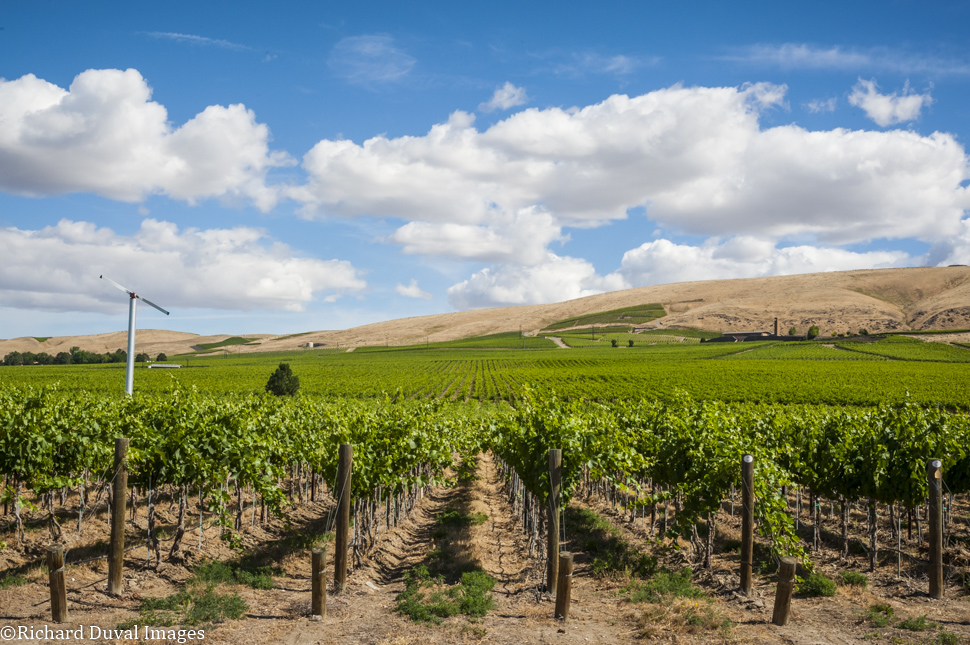
You start by implementing good land management practices before ever making an offer on a potential vineyard. Elements such as site selection, past crop history, slope, drainage, and quality of our nursery stock and pest-free plant materials were all taken into consideration during our land search. Selecting the right land means minimizing the risk of weather impacts such as freezing which can result in expensive replanting. We were fortunate to find the land that has since become our Ambassador Vineyard, which is situated in the world class growing region of Red Mountain. It’s gentle, southwest facing slope allows the frost to blow down the hill without settling on the fruit. In 2011, this advantage became glaringly evident as the majority of the state’s growing regions suffered large losses while Red Mountain emerged with some of the best fruit in the country.
We made a conscious decision to “enter backwards” because being able to control the quality of the fruit that goes into our bottles is critical. Controlling the quality starts with controlling and implementing sustainable farming practices. In our mind, this consists of 3 key factors:
- Being economically viable
- Being socially supportive
- Being ecologically sound
For these reasons we contracted with the top vineyard manager in the state of Washington, Dick Boushey. Dick’s farming practices are minimalistic. He uses technology sparingly but appropriately to maintain the integrity of the vines as well as the soil. In his mind it is all about moderation. Vineyards by nature are low-impact crops and water conservation and soil management are key aspects to the sustainability and health of the vines. Dick employs a drip irrigation system and only waters when necessary, there are no set watering schedules and no unnecessary waste. Dick uses an Integrated Pest Management (IPM) system which is a sustainable approach to managing pests by combining biological, cultural, physical and chemical tools in a way that minimizes economic, health and environmental risks. Dick only uses soft pesticides which are made to kill only targeted pests. He never uses broad spectrum pesticides and only uses the practice of spot spraying when absolutely necessary. Because he and his team do everything by hand, it is extremely important that only safe products are used to manage pests. Many of his practices are actually considered safer than organic farming which often requires weekly spraying.
Another striking aspect of Dick’s business is the fact that he does not utilize seasonal crews. He employs a permanent crew that works with him year round and pays above minimum wage. This aspect of stability in an industry that typically experiences great seasonal employment fluctuations has enabled him to nurture a crew that is as familiar with the vineyards that he farms as he is himself. In fact, many of his team members have been with him for over 15 years. Good land stewardship is the responsibility of every vineyard owner and one that we take very seriously. We cannot accomplish our goal of making a world class wine unless we nurture our vines in such a manner that promotes their health and well-being. Yes, we entered backwards but because of this, we have a marked advantage moving forwards.